目的地
八个市场,三个监管制度
The ten largest destinations took 60.5% of China's tea export value in 2025. These eight are the ones where a Fujian origin book and a refined volume book both have a route in.
实际上,中国茶去哪里?
China exported 418,800 tonnes of tea in 2025, up 11.9%, worth USD 1.55 billion. The top ten destinations by value — Morocco, Senegal, Malaysia, Mauritania, Ghana, Côte d'Ivoire, the United States, Japan, Uzbekistan, Algeria — took 60.5% of that value. Green tea was 88.11% of export volume.
| 目的地 | 地区 | Rank by value, 2025 | 大量 | 卷 年 月 日 | 价值 | 单位价格 | 时间 |
|---|---|---|---|---|---|---|---|
| 摩洛哥 | 北非 | #1 | 91,000 t | +13.4% | USD 280 m | USD 3,043.4 / t | 2025-01-01/2025-12-31 |
| 塞内加尔 | 西非 | #2 | 24,000 t | +61.4% | USD 98.4 m | USD 4,024.6 / t | 2025-01-01/2025-12-31 |
| 毛里塔尼亚 | 西非 | #4 | 20,116.7 t | +26.8% | USD 83.2 m | ≈ USD 4,136.9 / t | 2025-01-01/2025-12-31 |
| 加纳 | 西非 | #5 | 18,074.8 t | -53.2% | USD 72.4 m | ≈ USD 4,004.9 / t | 2025-01-01/2025-12-31 |
| 俄罗斯 | CIS | — | 15,900 t | -19.2% | — | — | 迄今为止的2025年份 |
| 乌兹别克斯坦 | 中亚 | #9 | 29,217.4 t | +17.3% | USD 61.5 m | ≈ USD 2,105.9 / t | 2025-01-01/2025-12-31 |
| 美国 | 北美 | #7 | 10,456.1 t | -11.8% | USD 66.4 m | ≈ USD 6,347.6 / t | 2025-01-01/2025-12-31 |
| 日本 | 东亚 | #8 | 11,192.4 t | +9.7% | USD 64.1 m | ≈ USD 5,725.4 / t | 2025-01-01/2025-12-31 |
Every volume is shown in tonnes. The Russia row comes from an industry series published in kilograms year-to-date, which the Period column marks; the other rows are full-year 2025 figures from the China Chamber of Commerce of Foodstuffs and Native Produce. A unit price marked ≈ is value divided by volume, calculated on this site. Unit prices are the figures published per destination, not a recalculation. Volumes and values are published rounded, so dividing a published value by a published volume can differ from the published unit price by about 2%. Sources are stated on each market page and in the 数据报告。
Routes we quote
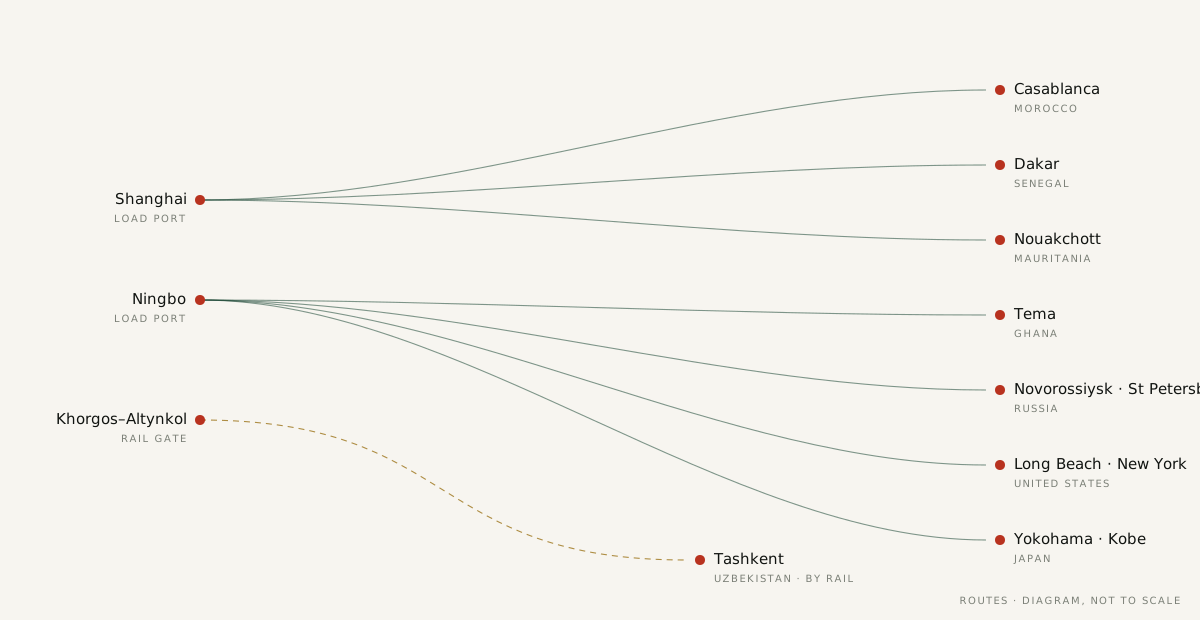
ODM Tea quotes sea freight loading at Ningbo or Shanghai for Casablanca, Dakar, Nouakchott, Tema, the Russian ports, the United States and Japan; Uzbekistan is quoted by rail through the Khorgos–Altynkol corridor, which changes the packing brief and the transit plan. FOB, CFR and CIF are sea-freight rules, so a rail shipment is quoted under an Incoterms rule for any mode of transport, named in the quotation. Shipment history for a lane is confirmed in the quotation. The diagram shows routes, not distances.
他们之间发生了什么变化?
Three things: the grade the market actually drinks, the regulator whose residue limit the lot must clear, and how the goods physically arrive. Morocco, Senegal and Ghana are quoted as sea freight out of Ningbo or Shanghai. Uzbekistan is landlocked and is quoted by rail through the Khorgos–Altynkol corridor, which changes the packing brief.

摩洛哥
The single largest destination for Chinese tea — more than a fifth of China's tea export volume in 2025.

塞内加尔
Second by value among China's tea markets in 2025, volume up 61.4% — and USD 4,024.6 per tonne, 32.2% above Morocco.

毛里塔尼亚
100% 毛里塔尼亚从中国购买的绿茶中,

加纳
作为重出口枢纽:在泰马登陆的茶将转移到马里,布基纳法索和尼日尔。

俄罗斯
Chinese tea volume into Russia fell 19.2% year-to-date in 2025, by an industry count, with green tea at 68% of the mix.

乌兹别克斯坦
Second only to Morocco by volume among China's ten largest tea markets: 29,217.4 tonnes in 2025, up 17.3%.

美国
Seventh by value on about a ninth of Morocco's volume — grade, not tonnage, sets the price.

日本
Among the strictest residue regimes of any major buyer, and with ASEAN a main destination for Fujian's tea exports.
常见问题
哪个国家进口最多的中国茶?
Morocco. It took 91,000 tonnes in 2025, up 13.4%, worth USD 280 million, up 14.7%, at an average USD 3,043.4 per tonne. 99.85% of China's shipments to Morocco are green tea.
哪个中国茶叶市场增长最快?
Among China's ten largest tea markets by value, Côte d'Ivoire: volume up 300.4% in 2025 to 16,701.2 tonnes. Senegal was second at +61.4%, Mauritania third at +26.8% and Uzbekistan fourth at +17.3%. Ghana fell furthest, down 53.2%.
哪些市场每钱最多?
Among the ten largest, Malaysia by far — about USD 21,175.5 per tonne, value divided by volume — then the United States and Japan at about USD 6,347.6 and USD 5,725.4. Senegal paid USD 4,024.6 and Morocco USD 3,043.4, against a national export average of USD 3,691.2.
适用于哪些监管制度?
Morocco applies ONSSA maximum residue limits under Order 156-14. The Eurasian Economic Union — Russia, Belarus, Kazakhstan, Armenia and Kyrgyzstan — applies TR CU 021/2011 for food safety and TR CU 022/2011 for labelling, evidenced by a registered Declaration of Conformity and the EAC mark. Uzbekistan is an observer state, not a member, so those regulations do not follow the goods there; national requirements apply and are confirmed with the importer. The European Union checks 20% of tea consignments from China for pesticide residues under Implementing Regulation (EU) 2026/194.
最后更新:2026年9月26日